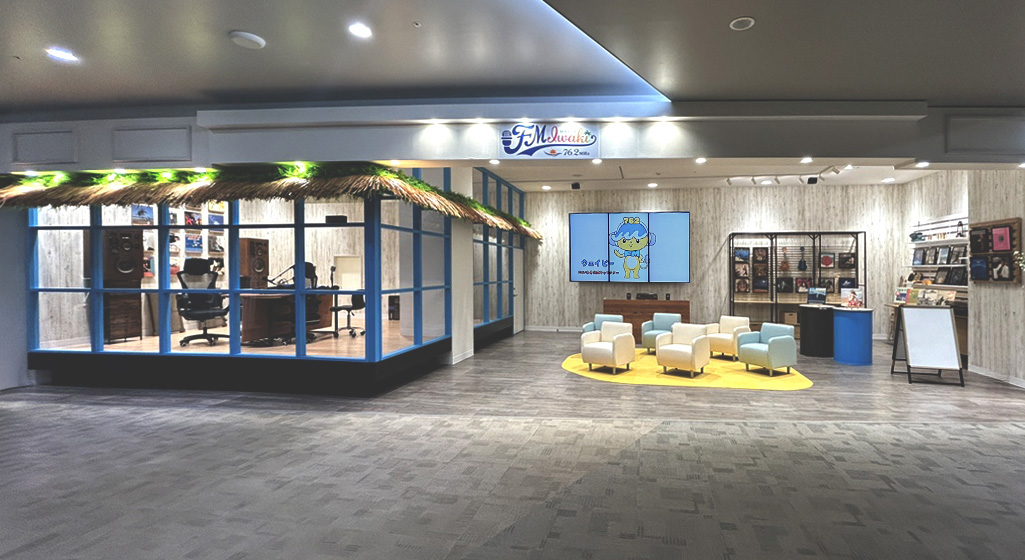
SEA WAVE FM Iwaki Satellite Studio (Aeon Mall Iwaki-Onahama), Interior Design
This project delivers a new satellite studio for SEA WAVE FM Iwaki (76.2 MHz), a community radio station in Iwaki City, Fukushima Prefecture. Established in 1996, the station provides local news and cultural programming, and also serves as a reliable channel for public information in emergencies. While its main base is located inland in Taira, the new satellite studio is positioned on the waterfront—inside Aeon Mall Iwaki-Onahama, facing Onahama Bay.
Iwaki City spans a remarkably wide geography, from forested mountains and former coal-mining landscapes to the rich seafood culture of the bay. Aeon Mall Iwaki-Onahama is a large, community-centered commercial complex whose overall spatial identity is strongly shaped by a Hawaiian / hula worldview—reflecting hula as one of Iwaki’s major subcultures. Locating the station’s satellite studio within the same tenant zone made it possible to align the mall’s hula atmosphere with the station’s “WAVE” identity and the imagery of the sea at Onahama, forming a cohesive design concept rooted in place.
Because the studio sits along the mall’s primary circulation route, the public recording booth is set on a slightly elevated stage to ensure visibility and to invite engagement without disrupting retail flow. Anticipating higher visitor volumes on weekends, the plan incorporates a dedicated crowd-absorbing pocket space within the tenant boundary, preventing congestion from spilling into the main commercial corridor. A display of records related to Fukushima, Iwaki, and Onahama—contributed in part by the station’s production staff—adds an archival layer to the interior, creating a small lounge-like moment where visitors can pause, browse album covers, and connect with the region’s cultural memory.